So in the last post
I recounted what Helsinki had to offer to me on Thursday while I was there,
continuing on with this theme I will share my favourite places in Helsinki from
the activities I did on Friday and Sunday.
Friday in Helsinki – Suomenlinna
Suomenlinna is an
island located just off the coast from Helsinki – it’s sea fortress dates back
to the 1700s when Finland was part of the Kingdom of Sweden. However although
its construction began during the Swedish rule, there are guns that face west
on the ramparts at Kustaanmeikka (an area on the island), which demonstrate the
period of Russian rule (in the 19th Century).
The island and sea fortress is a UNESCO World Heritage Site (since 1991) as its preservation will allow future generations to see the European military architecture of the 1700s.
The island is quite small, so it is easy to explore on foot. I didn’t visit all areas of the island, but I did of course visit one of the main parts of the fortress. It was actually a scary experience. I was by myself, so this clearly did not help ease my fear. I walked through the fortress and decided to wander through the old archways and see if I could find anything. It was a bad mistake – it was dark and cold, and no one was around. Suddenly I heard some eerie noises, and at the moment decided to walk quickly out and into the open space. I decided soon afterwards that it was haunted, and better to be visited in a group instead of alone. I can’t imagine what it must be like at night…
The island and sea fortress is a UNESCO World Heritage Site (since 1991) as its preservation will allow future generations to see the European military architecture of the 1700s.
The island is quite small, so it is easy to explore on foot. I didn’t visit all areas of the island, but I did of course visit one of the main parts of the fortress. It was actually a scary experience. I was by myself, so this clearly did not help ease my fear. I walked through the fortress and decided to wander through the old archways and see if I could find anything. It was a bad mistake – it was dark and cold, and no one was around. Suddenly I heard some eerie noises, and at the moment decided to walk quickly out and into the open space. I decided soon afterwards that it was haunted, and better to be visited in a group instead of alone. I can’t imagine what it must be like at night…


Since I was at
Suomenlinna in the morning, I decided to have my breakfast here. Now I had read
that traditionally Finns usually have coffee and a sweet bun (usually a
cinnamon bun) for breakfast. Keeping up with trying to embrace living like a
Finn, I decided to have the same – and to be honest I was gladly obliging since
I love coffee and anything sweet, so for me this was actually an ideal
breakfast. Unfortunately the café didn’t have any cinnamon buns, so I chose
something else, which I was later informed, consisted of butter and sugar in a
bun. I thought to myself that I was being incredibly unhealthy and was willing
myself to have a heart attack in the future from too much butter consumption –
yet, regardless it was a very tasty bun and didn’t seem to overpowering with
butter and sugar, there was a sort of calculated balance. The coffee was
amazing though. Usually I don’t like to drink coffee just black, it has to have
at least milk, and quite often I’ll take it with a teaspoon of sugar; but the
coffee here in Finland was really nice and I didn’t need to take it with milk
or sugar in order to enjoy it. (Lappish coffee was even better – but more will
be said about this in the next post).

Suvilahti Cultural Centre
Probably one of my
favourite places in Helsinki – it used to be an industrial area with the
Suvilahti power plant generating gas and electricity for Helsinki for much of
the 20th Century, but now it is a cultural haven. What I loved most
about the cultural centre is that it has kept the remains of the power plant,
so to any unknown walking they would still assume this is in fact an industrial
area.
Among the cultural events, they host open-air music concerts in the summer and circus performances. In fact, in 2013, Finland’s biggest circus school, Circus Helsinki, made Suvilahti their new home and area of practicing their performances.
Among the cultural events, they host open-air music concerts in the summer and circus performances. In fact, in 2013, Finland’s biggest circus school, Circus Helsinki, made Suvilahti their new home and area of practicing their performances.


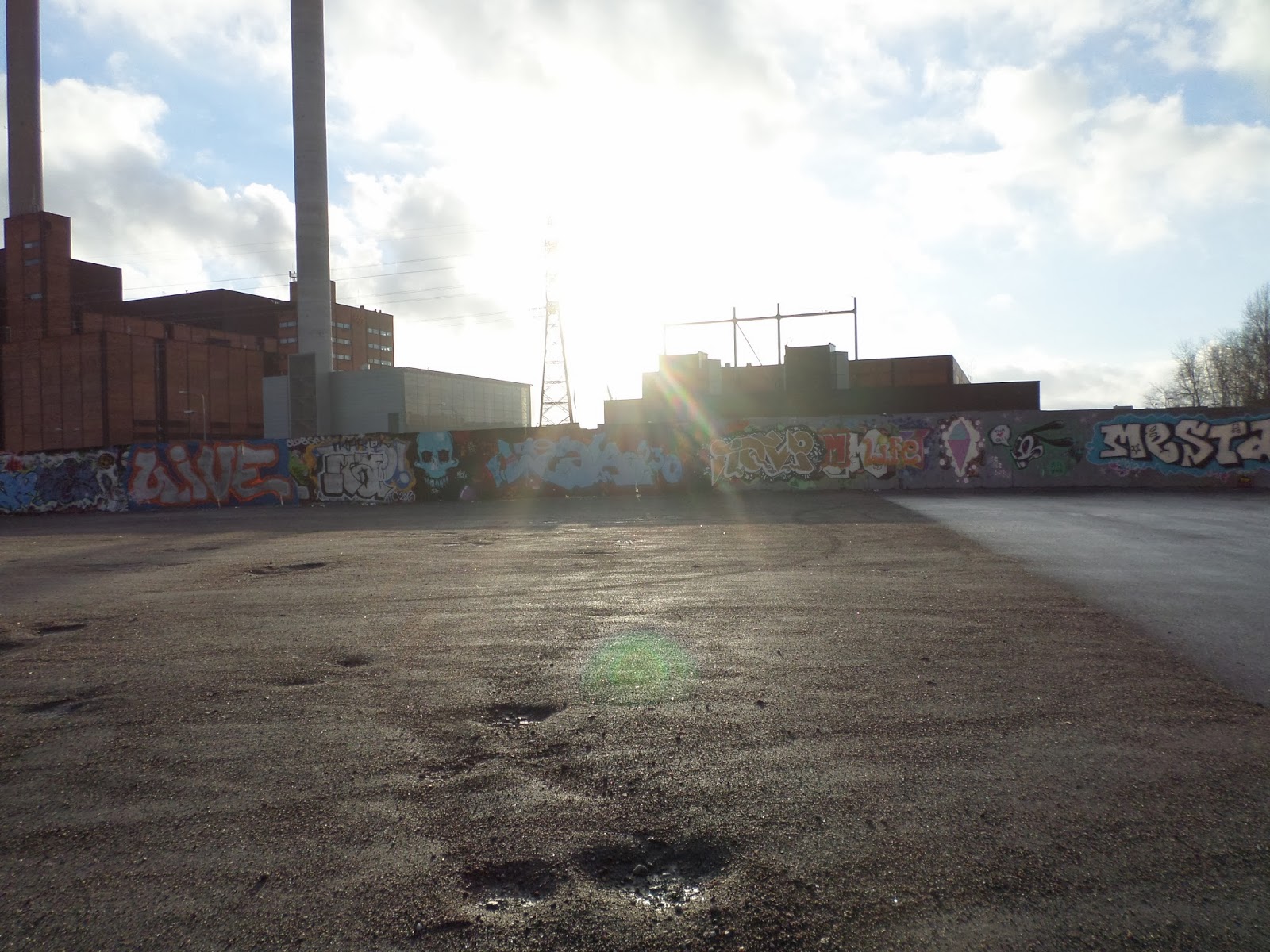
The cultural centre is big on creating culture and arts, and most of all to get
the youth involved. They even provided a wall whereby people could use it for
their graffiti art (instead of on the streets):


Hakaniemen Kauppahalli
This is an old
market hall not far from the Kallio district (definitely worth a visit, the
coolest vintage, antique, local designer, and record stores can be found in
this area) – but back to the market hall… When I mean market hall, I mean that
it is a market hall of food. As soon
as you walk through the arched doors you are immediately thrown face-to-face
with local produce. Walking around (I walked in a clockwise direction), I first
walked through the meat area; there were so many different cuts and types of
meat, I saw some that I was completely unfamiliar with. It was incredible, if
you are a lover of meat or wanted some fresh produce to make dinner, then this
was definitely the place to come. The only problem I had was that I hate the
smell of raw meat, and there was a LOT of raw meat so the smell was quite strong.
However if you keep walking around, you’ll begin to move away from meat and
towards the seafood area. Again, like with meat, if you are a seafood lover and
wanted to make lunch/dinner, this is an ideal place to stock up on ingredients.
Keep walking and you’ll soon leave behind the fish and arrive at the baked
goods section. All the lovely breads and pastries, this is definitely a nicer
smell than the raw meat and seafood. Continuing on, you’ll find yourself moving
away from the fresh produce and come to preserved jams and other goodies, like
chocolate! The chocolate they had looked incredible, but the price tag was
quite high, and while they did look like amazing chocolates, I really couldn’t
bear to part my money for a piece (and besides, their chocolate in the
supermarkets are by Karl Fazer, still amazingly delicious). The market hall
offered many areas to sit and eat, whether it be cafes or bakeries, so if
you’re lazy and don’t cook, you could still get a taste of Finnish local
produce.
I loved this market hall, and I think if I come back here (which I definitely will be trying my best to come back to Finland soon), then I would definitely get all my local produce here to make an awesome meal and feel good for supporting the Finnish local industry :)
I loved this market hall, and I think if I come back here (which I definitely will be trying my best to come back to Finland soon), then I would definitely get all my local produce here to make an awesome meal and feel good for supporting the Finnish local industry :)
Sunday in Helsinki – Design Museum
I went to the Design
Museum especially because I had read about their current exhibition: “Don’t
Shoot the Messenger: The Expanding Field of Graphic Design”. As I had mentioned
before in my last post, since I am particularly interested in topics like this
due to studying Communication & Media Studies, I have a massive interest in
the arts/culture and media industry.
While the Design Museum has a permanent exhibition on Finnish design over the decades – which I must say was incredibly interesting – my heart was beating towards the upstairs exhibition about graphic design.
My expectations I had of the exhibition were completely wrong, they were exceeded as the exhibition was much better than I had anticipated. There were designs by a range of artists from all over the world. There was one about the importance of poster art – it was stating how in today’s society there is an argument that with technology there is now no need for poster artwork and prints, but the artist disagrees. I do too. Especially since I have been part of the poster group for Hulen in Bergen, I can see there is a huge importance still for posters. People who are overcome by technology take for granted the importance of these artworks, but the thing is, if a person is walking down a street and there are posters placed on the wall, they will still catch your attention, regardless of whether you find out about upcoming events through social media. Back home, whenever I walk the streets in the city, I come across posters and I always stop to look at them, because sometimes there are events we miss seeing via digital media because we are too busy using it for other things, like socialising.
I found a pattern emerge with the exhibition – while I had originally thought with the title “The Expanding Field of Graphic Design”, the attention would be placed on digital graphic designing as we know it today, I was completely wrong – what I found was majority of the exhibits were graphic designers fighting against the digital age, all stating the importance of graphic design as a substance, an artwork that should still remain in the real world, not being swallowed up and overtaken by online media. All around the floor were many texts which asked questions about the importance of graphic design, and they helped not only make the exhibition an even more enjoyable experience, but it also provoked me to think more about my perception of graphic design.
While I loved all the artists’ works, there was one part of the exhibition I completely fell in love with. It was on the importance of books, not e-books, but the hardcover books that people have seemed to forget about with moving their lifestyles completely online. They had showcased loads of different books with placing the importance of their cover designs. There were long quotes placed around the rooms suggesting this – how we often sometimes will pick up a book just by being lured to the cover. While the saying goes “don’t judge a book by its cover”, the fact remains that the cover of a book is incredibly important. The cover of a book will reflect the story that’s within, or it’s a piece of the writer giving the reader slight glimpses into their unknown minds. The covers of a book are important, they speak so many words without us even realising it, and sadly people just often take it for granted. However, all book-lovers understand the gloriousness that not only comes with an amazing read, but the attractiveness of a book cover which we look at again and again and can evoke so much. Sometimes it can be completely simple, and provide no clues to what the novel is about, but that makes it even more alluring, because it holds secrets inside that you just have to discover.
All in all, I really appreciated the exhibition, and the team at Design Museum presented it in such an effective way that made the whole experience for me very thought-provoking, and I’m sure it did to many of the other visits, who I observed seemed glued to the various artworks.
While the Design Museum has a permanent exhibition on Finnish design over the decades – which I must say was incredibly interesting – my heart was beating towards the upstairs exhibition about graphic design.
My expectations I had of the exhibition were completely wrong, they were exceeded as the exhibition was much better than I had anticipated. There were designs by a range of artists from all over the world. There was one about the importance of poster art – it was stating how in today’s society there is an argument that with technology there is now no need for poster artwork and prints, but the artist disagrees. I do too. Especially since I have been part of the poster group for Hulen in Bergen, I can see there is a huge importance still for posters. People who are overcome by technology take for granted the importance of these artworks, but the thing is, if a person is walking down a street and there are posters placed on the wall, they will still catch your attention, regardless of whether you find out about upcoming events through social media. Back home, whenever I walk the streets in the city, I come across posters and I always stop to look at them, because sometimes there are events we miss seeing via digital media because we are too busy using it for other things, like socialising.
I found a pattern emerge with the exhibition – while I had originally thought with the title “The Expanding Field of Graphic Design”, the attention would be placed on digital graphic designing as we know it today, I was completely wrong – what I found was majority of the exhibits were graphic designers fighting against the digital age, all stating the importance of graphic design as a substance, an artwork that should still remain in the real world, not being swallowed up and overtaken by online media. All around the floor were many texts which asked questions about the importance of graphic design, and they helped not only make the exhibition an even more enjoyable experience, but it also provoked me to think more about my perception of graphic design.
While I loved all the artists’ works, there was one part of the exhibition I completely fell in love with. It was on the importance of books, not e-books, but the hardcover books that people have seemed to forget about with moving their lifestyles completely online. They had showcased loads of different books with placing the importance of their cover designs. There were long quotes placed around the rooms suggesting this – how we often sometimes will pick up a book just by being lured to the cover. While the saying goes “don’t judge a book by its cover”, the fact remains that the cover of a book is incredibly important. The cover of a book will reflect the story that’s within, or it’s a piece of the writer giving the reader slight glimpses into their unknown minds. The covers of a book are important, they speak so many words without us even realising it, and sadly people just often take it for granted. However, all book-lovers understand the gloriousness that not only comes with an amazing read, but the attractiveness of a book cover which we look at again and again and can evoke so much. Sometimes it can be completely simple, and provide no clues to what the novel is about, but that makes it even more alluring, because it holds secrets inside that you just have to discover.
All in all, I really appreciated the exhibition, and the team at Design Museum presented it in such an effective way that made the whole experience for me very thought-provoking, and I’m sure it did to many of the other visits, who I observed seemed glued to the various artworks.

Yrjönkatu Swimming Hall
I ended my weekend
in Finland in completely bliss and harmony - AND in a traditional Finnish way,
by going to one of the swimming halls to sit in saunas and swim in pools NAKED.
First things first, about the swimming hall: the Yrjönkatu swimming hall is absolutely beautiful, it was built in the 1920s and it features an interior of Roman archways and tiled floors. The colours of the archways are white and the walls are a beige colour, making the crystal clear blue of the swimming pool stand out. The pool really dominates your attention, especially if you’re on the second floor above. As you look over from the second floor, all you can see is the pool. It practically begs for attention, and you simply can’t look at it and not want to dip your toes in and submerge yourself for at least a quick swim. Apart from the swimming pool, there are also three saunas: one is electric, one is steam and the last is wood – which I was told was a proper traditional Finnish sauna. (I can’t remember if I went in the steam or the wood sauna, I would like to believe it was the wood sauna, but my feeling is that it was the steam one – which doesn’t matter, at least it is better than the electric one).
First things first, about the swimming hall: the Yrjönkatu swimming hall is absolutely beautiful, it was built in the 1920s and it features an interior of Roman archways and tiled floors. The colours of the archways are white and the walls are a beige colour, making the crystal clear blue of the swimming pool stand out. The pool really dominates your attention, especially if you’re on the second floor above. As you look over from the second floor, all you can see is the pool. It practically begs for attention, and you simply can’t look at it and not want to dip your toes in and submerge yourself for at least a quick swim. Apart from the swimming pool, there are also three saunas: one is electric, one is steam and the last is wood – which I was told was a proper traditional Finnish sauna. (I can’t remember if I went in the steam or the wood sauna, I would like to believe it was the wood sauna, but my feeling is that it was the steam one – which doesn’t matter, at least it is better than the electric one).
The rules of these
swimming halls are simple: men and women have separate hours (they do not swim
together), you must shower before going in the sauna/pool, and you can choose whether you want to swim naked or
not (it wasn’t until recently that this changed, I think sometime in the 2000s,
before it was compulsory to swim naked, but now they allow the options of
bathers if you wish – but where’s the fun in that?).
Now the day before I
was going to the swimming hall I had no doubts about getting my kit off to go
in the sauna and pool, however on the actual day when I was standing there in
my cabin, the decision to go bare was not as simple as I had thought. I lacked
courage, and it took me three trips to my cabin to finally wear my birthday
suit. These were how many attempts happened: 1) I arrived, looked over the
balcony to see who and how many were actually naked, there seemed to be only
older ladies which made me think perhaps it was only the traditional Finnish
women who still swim naked, so I went in my cabin and put my bathers on; 2) walked
out (you get giving bathrobes by the way, so you are not walking around naked,
only when in the saunas, showers and pool), saw there were more people in the
pool and walking around with their tops off but bather bottoms on, so I went
back to my cabin and took my bikini top off; 3) thinking I was ready to finally
relax, walked into the shower room where the sauna was and saw EVERYONE was
naked, all ages groups and there were many my age, alas I walked back my cabin
took off my bottoms and hence finally had the courage to be completely bare. I
thought to myself I would have stood out more for wearing my bathers than not
wearing anything at all.
The whole experience
was rather enjoyable actually, and completely relaxing. I went to the saunas
first and sat there for a while warming my body up. Satisfied I had enough
heat, I walked down the pool and swam some laps. There is something really so
liberating at swimming naked, it feels so natural that you start to begin
whether the inventions of bathers were really a good idea and that surely our
human bodies were designed to be nude in the water. When you swim naked, you
truly understand how constricting bathers are against actual swimming, I swear
the material must hold you back because when I was swimming my breaststroke
laps, I felt like I was gliding through the water (although I probably didn’t
look this way, more like a struggling marine animal who can’t swim properly).
As I started to feel like I had done enough laps, I headed back up to the sauna
for my last sweat session. I was in there longer this time, and oh boy did I
really sweat. It happened so suddenly, I felt a few drops coming off my back
then it all of sudden felt like rainfall was coming off my body! Clearly my
body obviously needed a desperate detox, and I felt I probably haven’t been
treating it with the best of love while I’ve been away – which is often the
case when you are away from the comfort of home. Afterwards, feeling like I
really shouldn’t sweat any longer or I could faint, I sat in the seat and
tables situated around the balcony and ordered a refreshing drink. It was
called “tuorepuristettu mehu” and was made up of apple, ginger and celery, and
it was meant to be detoxifying. It was really refreshing and tasty, but it went
away too quickly – definitely needed a bigger glass!

(NB: see more about the swimming halls in the upcoming post)
No Sunday Brunch??
The only thing I
found strange about Finland was that there were no cafes or restaurants open on
a Sunday (except for a select few scattered around). What made me found it even
weirder was because the shopping malls were still open – I could understand if
the shops were closed then perhaps cafes/restaurants would be closed too.
It was very bizarre, and I wondered whether there is a tradition on a Sunday for Finnish people to stay home and cook?
Regardless of this, I could still easily live in Finland though, and I would just make an amazing Sunday brunch and dinner at home after buying all my produce from the market hall. I think my ideal Sunday would be a morning walk along this beautiful park (on a street called Merisatamanranta), then make a mouth-watering brunch, followed by a visit to the swimming halls in the afternoon, then dinner and a movie or book on a comfy couch. Aw simply bliss! I’ll somehow have to try create a similar day back home in Perth I think.
It was very bizarre, and I wondered whether there is a tradition on a Sunday for Finnish people to stay home and cook?
Regardless of this, I could still easily live in Finland though, and I would just make an amazing Sunday brunch and dinner at home after buying all my produce from the market hall. I think my ideal Sunday would be a morning walk along this beautiful park (on a street called Merisatamanranta), then make a mouth-watering brunch, followed by a visit to the swimming halls in the afternoon, then dinner and a movie or book on a comfy couch. Aw simply bliss! I’ll somehow have to try create a similar day back home in Perth I think.
I have only the best
memories of Finland, there was not one bad thing about the place, and I will
truly miss it deeply in my heart.


